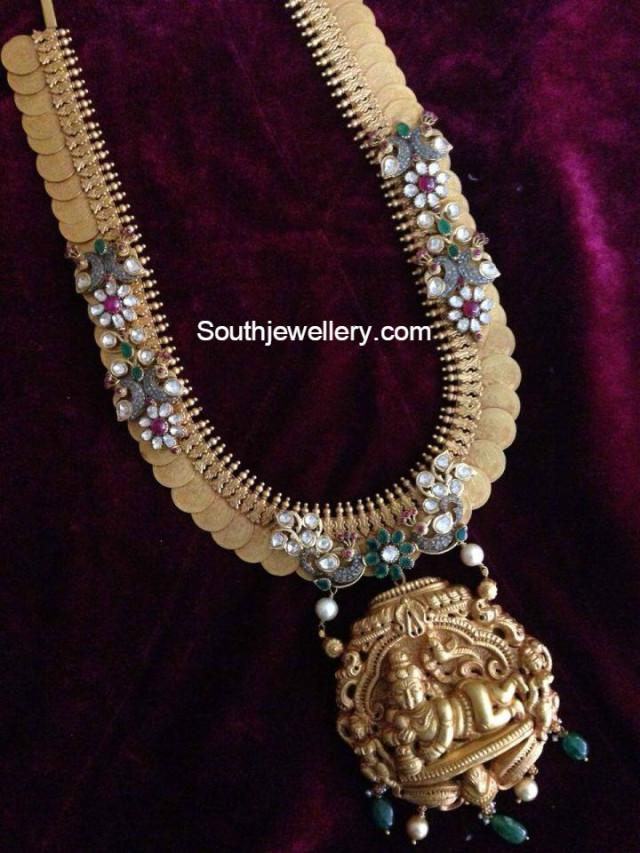
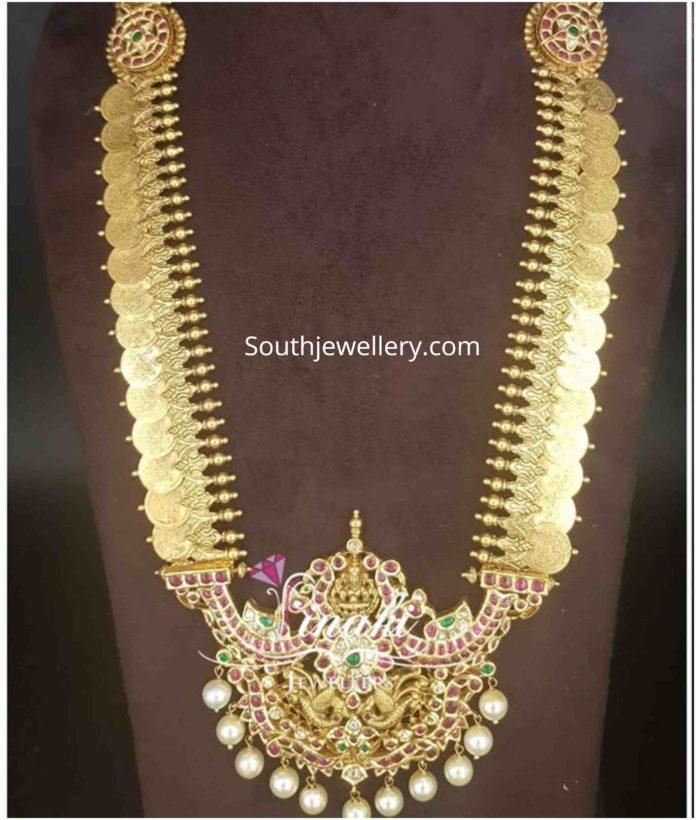
[PHOTO: A full-length antique gold Lakshmi kasu haram laid out flat so every coin is visible. Use the first photo from /2023/04/antique-gold-lakshmi-kasu-haram-7.html]
Few pieces of South Indian jewellery are as loved, or as lasting, as the necklace made of coins. Whether you call it a kasu mala, a kasulaperu, a kasu haram or a Lakshmi haram, the idea is the same: a row of small gold discs, each stamped with the goddess Lakshmi, strung together and worn as a blessing as much as an ornament.
This guide explains what these necklaces are, how they are built, how lengths and layering work, and how to wear them with confidence, from a quiet puja morning to a full bridal look.
What Is a Kasu Mala?
"Kasu" simply means coin. A kasu mala is a garland ("mala") of coins. In Telugu homes you will also hear kasulaperu (literally a string of coins), and in many families the longer version is called a kasu haram. Tamil and Kannada households use their own words, and the exact name varies by region and even by family, so do not be surprised if a jeweller and your grandmother use different terms for the same piece.
The Lakshmi coin is the heart of it. The goddess is usually shown seated on a lotus, often flanked by two elephants pouring water over her. This is the Gajalakshmi form, associated with prosperity, and it is why the necklace has always been a favourite for weddings, housewarmings and festivals such as Varalakshmi Vratham and Diwali.
How a Lakshmi Coin Necklace Is Built
Understanding the construction helps you judge a design and choose the right one for yourself.
The coins
Each coin is a small embossed disc. In the classic style, every coin carries the seated Lakshmi, and the discs are strung in a single line. Coin size, thickness and the sharpness of the embossing all change the look. Smaller coins sit delicately and suit everyday wear. Larger, bolder coins make a statement piece.
The spacers and the string
Between the coins you will often see small gold beads, or sometimes pearls, corals or tiny stone-set spacers. These keep the coins from crowding each other and add rhythm. Some designs use a single line of coins, while others stack two or three lines, or add stepped rows that fall into a wider shape at the centre.
The pendant
Many kasu harams end in a pendant, most often a larger Lakshmi, a peacock, or a kundan-set medallion. A pendant gives the necklace a focal point and a gentle weight so that it hangs straight against the body.
Popular Kasu Mala and Lakshmi Haram Designs
Plain antique gold Lakshmi kasu haram
The classic. Matte, warm gold coins on a long strand, with no stones to distract. It is timeless and works across generations. See the simplicity of this antique gold Lakshmi kasu haram and another clean example for the pure form.
Nakshi Lakshmi haram
Nakshi is fine hand-engraved work, and on a coin necklace it shows up as intricate detailing around the goddess and along the border of each disc. The result feels richer and more crafted. Compare the detail in this antique gold nakshi Lakshmi haram and this nakshi kasu haram.
Kasu haram with a kundan pendant
Here a row of plain gold coins leads to a bright kundan-set pendant. The contrast between the soft antique finish and the sparkle of the pendant is striking and photographs beautifully. Good references are this kasu haram with kundan pendant and this Lakshmi haram with a kundan pendant.
Peacock and Lakshmi combinations
The peacock is another auspicious motif in South Indian jewellery, and it pairs naturally with the coin necklace, either as a pendant or as a matching piece worn alongside. Look at this peacock Lakshmi kasu necklace and this peacock and Lakshmi haram pairing.
Haram with pearls or corals
Adding pearls or corals between the coins softens the gold and adds colour. A pearl-spaced haram feels gentle and festive, while coral gives a deeper, traditional warmth. See a Lakshmi haram with pearls and one with corals.
Layered Lakshmi kasu necklaces
Some designs build the layering into the piece itself, with two or three coin lines of different drops joined at a single clasp, so you get the stacked effect without arranging separate necklaces. This layered Lakshmi kasu necklace shows how rich that can look.
Black thread with a polki pendant
A more modern take places a Lakshmi kasu haram beside a black thread necklace carrying a polki pendant. It keeps the tradition of black beads or thread, long believed to ward off the evil eye, while giving the look a contemporary edge. Here is one such pairing.
Lengths: Choker, Necklace and Long Haram
The word "haram" itself signals length, so choosing the right drop matters as much as choosing the design. Exact measurements vary from maker to maker and from person to person, so treat the following as a general guide rather than a rule.
- Choker length: sits snug at the base of the neck. A short coin line works well here for those who like a contained, collar-style look.
- Short necklace: rests around the collarbone. Good for everyday wear and for necklines that are high or modest.
- Mid-length: falls to the upper chest. This is the most versatile length and layers easily under a longer piece.
- Long haram: falls to the chest or past it, sometimes reaching the waist. This is the length most people mean when they say Lakshmi haram or kasu haram.
If you are petite, a very long haram can overwhelm the frame, so a slightly shorter drop often looks better. On a taller frame, a longer haram elongates the line beautifully. Always check the length against your own height and your blouse neckline, ideally by trying the piece on or comparing it with a necklace you already know.
How to Style a Kasu Mala
With a silk saree
The kasu haram and the silk saree are a natural match. The warm gold of the coins echoes the zari border, and a long haram falls neatly over the pleats and pallu. For a wedding saree with heavy zari, a plain coin haram keeps the look balanced. For a simpler silk, a nakshi or pendant haram adds interest.
Pairing with a choker
One of the most popular looks is a close-fitting choker with a long Lakshmi haram. The two together frame the neck and chest without competing. See how it is done with a peacock nakshi choker and Lakshmi haram, a CZ choker and Lakshmi haram, and a simple peacock choker with a Lakshmi haram.
[PHOTO: A choker worn together with a long Lakshmi haram, showing both pieces at once. Use /2023/02/antique-gold-peacock-nakshi-choker-and-lakshmi-haram.html]
Matching jhumkas
Traditional coin necklaces are often sold with matching earrings. Classic gold jhumkas, called buttalu in many Telugu homes, finish the set neatly. Browse this Lakshmi haram and jhumkas set, a kasulaperu haram with buttalu, and an antique gold kasu necklace with jhumkas.
Layering two necklaces
To layer without it looking cluttered, vary the length and the texture. Pair a shorter, simpler necklace with a longer coin haram, so the lines fall at different points. The older, more traditional approach is to wear a short kante-style necklace and a long kasu haram together, as in this kante necklace and kasu haram.
For brides
A bridal look is usually built in stages, and the Lakshmi haram traditionally takes its place after the shorter pieces. A common order is choker, then a short necklace, then the long haram, finished with a tikka, jhumkas and bangles. Families differ on exactly which pieces are worn and in what order, so follow your own tradition. For inspiration, see this bridal nakshi Lakshmi haram and another antique gold bridal Lakshmi haram.
Choosing the Right One for You
- Think about occasions. A plain coin haram is easy to wear often. A nakshi or pendant piece is better saved for bigger days.
- Check the weight and feel. A necklace you are comfortable in is one you will actually wear.
- Look at the embossing. Clear, well-defined Lakshmi on every coin is a sign of careful making.
- Match your wardrobe. Rich silks suit bolder designs, while lighter sarees and festive salwars suit smaller coins.
- Consider how it will be passed on. Simple coin necklaces are often kept for generations, so a classic design tends to age well.
Caring for Your Kasu Mala
Antique-finish gold is meant to look soft and slightly aged, so avoid harsh polishing. Wipe it gently with a soft dry cloth after wearing, store it in a cloth pouch away from perfume and moisture, and keep it separate from other pieces so the coins do not scratch each other. Get the string checked now and then, since a worn thread is the usual reason a long coin necklace breaks.
FAQ
What is the difference between a kasu mala and a Lakshmi haram?
They overlap a great deal. Kasu mala usually refers to any garland of coins, while Lakshmi haram points to a longer necklace featuring the goddess Lakshmi on the coins. In everyday use, many people use the names interchangeably, and regional habits vary.
Can I wear a Lakshmi coin necklace every day?
Yes, especially a simple, lightweight one. Many families treat it as a regular piece, with heavier or more ornate versions kept for weddings and festivals.
What length of kasu haram suits me best?
It depends on your height, your neckline and how you plan to layer. A mid-length drop is the most versatile, while a long haram looks lovely on a taller frame or over a plain blouse. Trying the piece on is the surest way to decide.
Can I wear a kasu haram with western outfits?
You can. A longer coin chain over a plain, solid-colour kurta or even a simple top gives a traditional accent to a modern outfit. Keep the rest of your jewellery minimal so the necklace stands out.
Why is Lakshmi shown on the coins?
Lakshmi is the goddess of wealth and good fortune in Hindu tradition, so a necklace of her coins is worn as a symbol of prosperity and blessing as well as for beauty.
How do I keep a long coin necklace from tangling?
Store it flat or loosely coiled in a soft pouch, and fasten the clasp before putting it away. Avoid piling other chains on top of it.