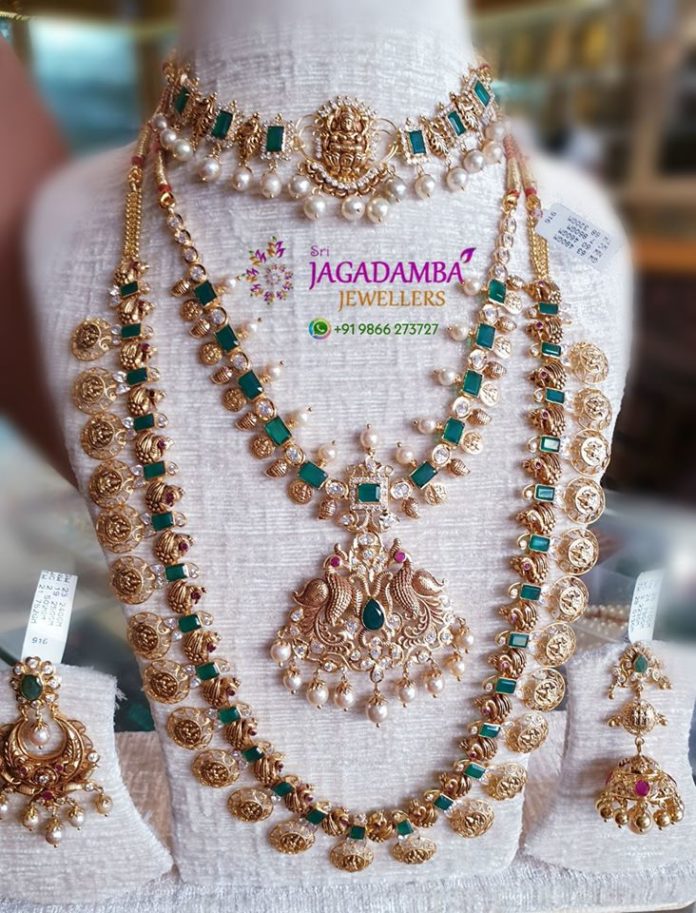
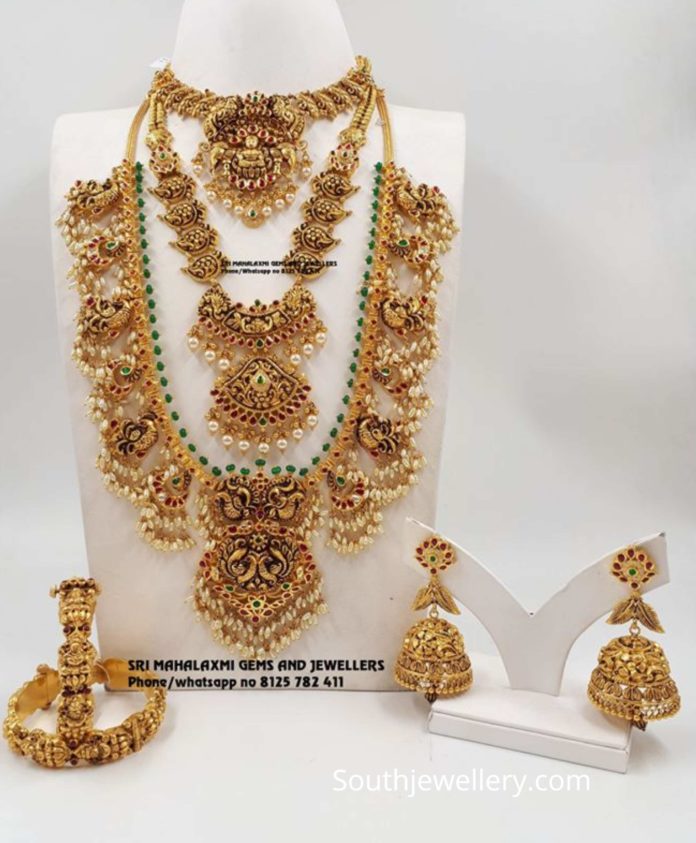
[PHOTO: one clear, full-length view of an antique nakshi Lakshmi haram, to open the guide. Best source: /2023/04/antique-gold-nakshi-lakshmi-haram-3.html]
Temple jewellery is the oldest living jewellery tradition in South India. It carries gods, flowers, birds and sacred symbols, and it is worn for weddings, festivals and classical dance. This guide explains what makes a piece "temple" jewellery, which deities and motifs you will see, what the traditional pieces are called, and how to tell good craftsmanship from a casual copy. You can use it as a checklist when you shop, or simply to read what is in front of you.
What is temple jewellery?
The name comes from the origin of the designs. Jewellery of this kind was made to adorn the deities in temples, and it was also worn by devotees, dancers and royal families, who offered and wore pieces in the same style. Over time the look became a bridal and festive tradition across the southern states.
Three things usually mark a piece as temple jewellery:
- Sacred imagery: a deity, a lotus, a peacock or another auspicious motif forms the centre of the design.
- Rich, rounded gold work: the metal is the hero, often with a warm antique finish rather than a mirror shine.
- A bold, structured shape: layered tiers, hanging drops and strong outlines that read well from a distance, as they would in a temple hall or on a stage.
Styles differ from region to region and from family to family. Tamil, Telugu, Kannada and Malayali traditions each have favourite motifs and piece names, so the same object may be called different things in different homes.
The gods and goddesses on temple jewellery
Lakshmi: the most loved motif
Goddess Lakshmi, the giver of wealth and good fortune, is the signature figure of South Indian temple jewellery. She is usually shown seated on a lotus, often flanked by elephants, with her hands in a blessing pose. A Lakshmi pendant on a haram, a Lakshmi choker or Lakshmi coins strung into a mala are all standard bridal choices, and they are especially favoured for Varalakshmi vratham.
To see the range, compare an antique Lakshmi nakshi choker, an elegant Lakshmi nakshi necklace and a gold balls mala with Lakshmi side pendants. The goddess is the same, but the settings are quite different.
[PHOTO: close view of the seated Lakshmi figure with lotus and elephants. Best source: /2023/10/antique-lakshmi-nakshi-choker.html]
Krishna, Venkateswara and other deities
Lord Krishna, often as the child with a flute or in the Balaji or Venkateswara form, appears on pendants and haram centrepieces. A pendant like this antique Lord Krishna pendant can be worn on its own chain or added to a longer set. Other deities, such as Ganesha, Radha-Krishna pairs and the dancing Nataraja, turn up on pendants, bangles and waist belts, depending on the family's devotion and the region.
Motifs and what they mean
Beyond the gods, a small vocabulary of motifs repeats across the tradition. Learning them makes any piece easier to read.
Peacock
The peacock is the second great motif after Lakshmi. It stands for grace, beauty and the arrival of the rains, and it is linked to Lord Murugan and Lord Krishna. Peacocks are worked into necklaces, jhumkas, bangles and tikkas, often with fanned tails set with stones. See the range in an antique gold nakshi peacock necklace, a pair of antique nakshi peacock jhumkas and a set of Lakshmi and peacock nakshi bangles. For a design that puts both icons together, look at this Lakshmi peacock bottu necklace.
Mango (manga or mamidi)
The mango shape, a tapering paisley-like drop, is a symbol of fertility and abundance. It is traditionally strung in rows to make a mango mala or haram. A good example is the antique gold mango nakshi necklace, and the motif also combines well with a goddess, as in the antique nakshi Lakshmi mango mala and jhumkas set.
Kasu (coins)
Kasu are small coin-like discs, often with Lakshmi stamped on each one, and they stand for prosperity. Strung close together they form a kasu mala or kasulaperu, and with a pendant or longer drop they become a kasu haram. Examples include an antique gold Lakshmi kasu haram and a Lakshmi kasu haram with a temple pendant.
Flowers, lotus and leaf work
Lotus petals, jasmine buds and leaf scrolls form the frame around the main figure. The lotus is the seat of Lakshmi, so it is nearly always present on her pieces.
Kundan, jilebi and geometric forms
Some temple sets mix in flat-set stones in a gold frame, or twisted spiral shapes, to add colour and rhythm. Compare the antique gold kundan temple haram and jhumkas and the kundan jilebi necklace to see how the same temple spirit can look more colourful or more austere.
The classic pieces, from neck to waist
A full traditional set is built from many pieces, and each has a name you will hear in the shop. The names below are the common ones used in Telugu and Tamil homes. Other regions use different words for the same things.
Choker
A close-fitting collar that sits at the base of the throat. In temple jewellery it is usually a broad band with a central deity and hanging drops. See the antique gold Lakshmi choker for the standard form.
Necklace and haram
The necklace sits on the collarbone; the haram is a longer piece that falls to the chest or waist. A heavy antique gold nakshi haram is the centre of most bridal sets, and the lengths may be doubled or tripled for layering. A temple nakshi haram usually carries large figural panels along its length.
Guttapusalu and nallapusalu
Guttapusalu are clusters of small pearls or beads grouped in bunches, strung on gold. The name suggests bunches of pearls, and the style is a Telugu favourite. See an antique guttapusalu haram and the more ornate Victorian guttapusalu haram. Nallapusalu are the black-bead strands that make the mangalsutra. Both can be paired with a temple choker, as in the Lakshmi choker and guttapusalu haram.
Jhumkas and buttalu
Bell-shaped earrings are called jhumkas, and in Telugu homes the deep, round bridal ones are often called buttalu. The temple version often carries a small deity or a peacock on top. The peacock nakshi kundan jhumkas show the shape well.
Vaddanam (waist belt)
The vaddanam, also called oddiyanam or kamarband in other regions, is a broad belt worn at the waist over a saree. It keeps the pleats in place and completes a bridal look. The antique gold nakshi haram and vaddanam set and the antique Lakshmi kundan necklace, haram and vaddanam show how the belt echoes the necklace motifs.
Bangles, vanki and tikka
Temple bangles are often broad kadas with figural work, while the vanki is the armlet worn on the upper arm. A tikka or maang tikka sits on the parting and may carry a small deity or peacock. These smaller pieces carry the same motifs as the main set so the whole look feels designed together.
How temple jewellery is made: nakshi and antique finish
Nakshi is the craft of hand-carving, chasing and embossing gold to raise figures and fine detail from the surface. It is slow, skilled work, and it is why a good piece has crisp faces, clear petal lines and a sculpted feel. Many of our featured pieces are described as antique gold nakshi jewellery, which means the gold has been treated to a soft, darker, matte tone that makes the carving stand out.
When you look at a piece, these are the signs of quality worth checking:
- Clear features: the face, hands and lotus of a deity should be defined, not blurred.
- Clean finish: the antique tone should be even, with no patchy colour.
- Secure settings: any stones, pearls or beads should sit firmly in their frames.
- Balance: a heavy pendant needs a good chain or back support so the piece sits well.
Stones vary by piece. You will see polki and uncut diamonds, rubies, emeralds and pearls added for colour, as in the nakshi emerald haram set. A stone-set piece is a different price and care story from plain gold, so ask what is in the setting before you buy.
Temple jewellery for brides
Temple jewellery is a natural choice for a South Indian wedding because the deities bring blessings along with beauty. A bridal set is usually layered, and the usual order from the neck down is a choker, a shorter necklace, one or more long harams, then the vaddanam at the waist, with a tikka, jhumkas and bangles to finish. You can see a full look in this antique gold bridal nakshi jewellery set and in more bridal sets such as this one.
[PHOTO: a complete bridal set shown as layers from choker to long haram. Best source: /2023/04/antique-gold-bridal-nakshi-jewellery-set-3.html]
Families often have their own sets passed down, so a bride may mix inherited pieces with new ones. The mix is normal, and the common motifs make old and new look right together.
Temple jewellery on the red carpet and screen
Actresses regularly wear temple jewellery with sarees and lehengas for festivals and premieres, and it shows how well the style carries into modern looks. A few examples: Tamannaah Bhatia in antique nakshi jewellery, Raashi Khanna in antique gold nakshi jewellery and Krithi Shetty in antique nakshi jewellery. In each case the jewellery does the talking, so the outfit is kept simple.
How to wear temple jewellery well
- Pick one hero: if the necklace is heavy, keep the earrings and bangles quieter, or the reverse.
- Match the metal tone: wear antique gold with warm silks and rich borders; it looks strongest against deep colours like maroon, green and royal blue.
- Mind the neckline: a high or boat neck suits a choker, while a deeper neck gives a long haram room to fall.
- Layer by length: choose lengths that are clearly different so the pieces do not tangle.
- Keep it comfortable: heavy sets are worn for hours, so check the weight and the clasps.
Caring for temple jewellery
Store each piece separately in a soft pouch so figures and stones do not rub. Keep it away from perfume, water and sweat, and wipe it gently with a dry soft cloth after wearing. Avoid harsh cleaners, since they can strip the antique finish. For polki, pearls and stones, ask your jeweller for the safest cleaning method.
FAQ
What makes jewellery "temple jewellery"?
It is defined by sacred motifs such as Lakshmi, peacocks and lotuses, by rich hand-worked gold, and by bold structured shapes. The design originates from jewellery made to adorn temple deities.
Which deity is most common on temple jewellery?
Goddess Lakshmi is the most common, usually seated on a lotus. Krishna, Venkateswara and Ganesha also appear, depending on the region and family.
What is the difference between a haram and a necklace?
A necklace sits close to the collarbone, while a haram is longer and falls to the chest or waist. Many bridal sets include both so they can be layered.
What does nakshi mean?
Nakshi is the hand-carving and embossing of gold to raise figures and fine detail. It gives temple pieces their sculpted look.
What are guttapusalu and kasu?
Guttapusalu are clusters of small pearls or beads strung on gold, popular in Telugu tradition. Kasu are coin-like discs, often showing Lakshmi, strung into a mala or haram.
Is temple jewellery only for weddings?
No. It is also worn for festivals like Varalakshmi vratham, for classical dance and for formal occasions. Lighter pieces like jhumkas and pendants work for everyday celebration wear.