
[PHOTO: a full bridal antique gold Lakshmi vaddanam worn over a silk saree, clear view of the front panel and the chain; use /2021/09/antique-gold-bridal-lakshmi-necklace-haram-and-vaddanam-set.html]
The vaddanam is the South Indian waist belt, worn over the saree at the hips. It is called oddiyanam in Tamil and Telugu, vaddiyanam in some spellings, and simply a waist belt or kamarbandh in English. It is one of the most important pieces in a South Indian bride's jewellery and almost never missing at a wedding. This guide explains what a vaddanam is, the main types, the motifs and stones you will see, how to wear it and how to choose one that suits you.
What is a vaddanam?
A vaddanam is a broad belt of gold, antique gold or diamonds, worn at the waist over the pleats of a saree. It holds the pallu and pleats in place and adds a strong line of jewellery to the lower half of the outfit. Most are made of a decorative front panel with connected links or a chain on either side, closing with a hook or screw at the back.
In Andhra, Telangana, Tamil Nadu and Karnataka the vaddanam is part of the traditional bridal set. Families have their own customs about when it is worn and how heavy it should be, so ask elders in your family what is expected for the ceremony.
Main types of vaddanam designs
Antique gold and nakshi vaddanam
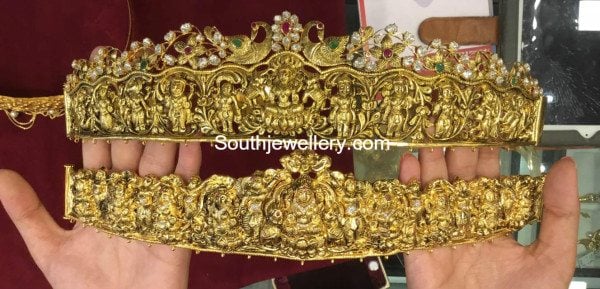
This is the classic temple-style vaddanam. The surface has an antique or matte finish, and the motifs are carved in fine nakshi work. Lakshmi is the most loved motif, and many panels also carry peacocks, elephants, lotuses and floral borders. You can browse antique gold Lakshmi vaddanam designs, an antique gold nakshi Lakshmi waist belt and a deep nakshi vaddanam to see how much the carving depth changes the look.
[PHOTO: close-up of deep nakshi carving on a Lakshmi panel; use /2021/05/antique-gold-deep-nakshi-vaddanam.html]
Diamond vaddanam
Diamond vaddanams are lighter in feel and brighter on camera. They suit evening receptions and brides who prefer a modern look. Designs include florals, paisleys and peacocks, often with emerald or ruby accents. See the latest diamond vaddanam designs, a floral diamond vaddanam and a paisley design diamond vaddanam. The newer diamond vaddanam designs continue the trend.
Diamond and emerald vaddanam
Green emeralds against white diamonds are a favourite bridal pairing. The diamond and emerald bridal vaddanam and bridal diamond emerald vaddanam show how emeralds can be used as drops, as centre stones or as a full colour border. A closed setting diamond and emerald vaddanam gives a smooth, polished surface compared with open settings.
Polki and kundan vaddanam
Polki, which uses uncut diamonds, and kundan give a richer, more traditional glow than cut stones. A Victorian polki vaddanam has a delicate, vintage feel, while the kundan vaddanam is bolder. For a mix of finishes, try an antique gold nakshi kundan vaddanam.
Peacock vaddanam
The peacock is a very common motif because it suits the curved shape of a belt. See a diamond peacock vaddanam, a peacock polki bridal vaddanam and a peacock nakshi vaddanam with Lakshmi pendant that combines two motifs.
Two-in-one and multi-use vaddanam
Convertible pieces give you more wear for the money. A 2 in 1 reversible gold vaddanam has a different design on each side. A 2 in 1 polki vaddanam plus choker splits into a belt and a neckpiece, and a 3 in 1 haram, jada, vaddanam stretches the idea even further. These suit families who want one investment to serve several occasions.
Baby vaddanam
Small versions are made for children, often with a deity pendant, for naming ceremonies, festivals and traditional functions. See a baby vaddanam with Ram Parivar pendant and a 2 in 1 baby vaddanam plus diamond choker.
Common motifs and what they mean
- Lakshmi: the goddess of wealth, central to bridal temple jewellery and the most traditional choice.
- Peacock: beauty and grace, and a natural fit for the belt's shape.
- Elephant: strength and good fortune. See an antique gold peacock and elephant nakshi vaddanam.
- Annapakshi (swan): a graceful bird motif seen in the Lakshmi and annapakshi diamond vaddanam.
- Floral and paisley: lighter, more modern, and good for diamond pieces.
Stones and finishes
Antique gold relies on the metal and its carving, sometimes with small ruby or emerald touches. Diamond pieces use white diamonds with coloured stones as accents. Polki uses uncut diamonds and has a softer sparkle. Pearls are often added as drops or borders, as in a diamond vaddanam with emerald and pearls. Rubies add depth, as in a diamond and ruby vaddanam.
How to wear a vaddanam
- Wear it over the saree, at the waist or slightly below it, sitting over the pleats and the pallu.
- Fit it snugly so it does not slide when you walk or sit. Most can be adjusted by a jeweller.
- Keep the front panel centred and visible.
- Wear it with a silk saree whose border is not too heavy, so the belt stays the focus at the waist.
Matching a vaddanam with the rest of the set
Bridal jewellery is usually worn in a set order: choker, necklace, long haram, vaddanam, tikka, jhumkas and bangles. Keep the metal and finish consistent. An antique gold vaddanam goes with antique necklaces, as in the antique gold nakshi haram and vaddanam set and the antique Lakshmi kundan necklace, haram and vaddanam. For diamonds, see the diamond emerald choker and vaddanam, the diamond necklace, step haram and vaddanam and the polki diamond haram and vaddanam. You can also see a diamond belt with bangles in diamond vaddanam and bangles.
How to choose the right vaddanam
1. Decide the occasion
For the muhurtham in a silk saree, antique gold with Lakshmi is the traditional pick. For a reception, diamond or polki often suits better.
2. Match your outfit and other jewellery
Choose the vaddanam last or alongside the necklace so that finishes agree. Too many heavy pieces competing will look crowded.
3. Consider your build and comfort
A broad belt looks striking on a tall frame, while a slimmer one often suits a petite bride. You may wear it for hours, so check weight and edge comfort.
4. Think about reuse
Convertible and reversible designs give you more value. A plain, well-made antique vaddanam also works for many festivals after the wedding.
5. Check the build quality
- Links should move smoothly without catching the saree.
- The back of the panel should be finished and smooth.
- The clasp should be secure and easy to fasten.
- Stones should be firmly set with no loose ones.
6. Follow family tradition
Some families prefer a particular motif or metal, and customs differ by region and community. It is worth asking before you buy.
Caring for your vaddanam
- Store it flat or in a soft pouch, away from other pieces that can scratch it.
- Wipe with a soft dry cloth after wearing. Avoid perfume and water on stones and antique finishes.
- Have a jeweller check the clasp and settings from time to time.
FAQ
What is the difference between vaddanam and oddiyanam?
They are the same piece. The name changes with language and spelling, and you may also see vaddiyanam, waist belt or kamarbandh.
Is a vaddanam only for brides?
Brides wear it most, but it is also worn at festivals, family functions and traditional ceremonies. Smaller versions are made for children.
Which is better, antique gold or diamond?
Neither is better. Antique gold is traditional and suits rituals. Diamond is lighter and brighter and suits receptions. Many brides choose both for different functions.
Can I wear a vaddanam with a lehenga or a half saree?
Yes. It works over a half saree, and many wear it on a lehenga, though the placement changes with the outfit.
How do I stop it from slipping?
Choose the right size, wear it snugly over the pleats, and ask your jeweller to adjust the length if needed.
Is a two-in-one vaddanam worth it?
If you want one piece for several uses, such as a belt that becomes a choker, it can be good value. Check that each form looks good on its own.


